
Inovasi Code Blue Fakultas Ilmu Keolahragaan Universitas Negeri Malang Sebagai Model Tanggap Darurat Medis di Perguruan Tinggi
Authors
-
Kumoro Asto Lenggono
 University of Malang
-
Moh Yudha Isnaini
University of Malang
-
Fajar Raya Ferdinal Kusuma Bakti
University of Malang
-
Kurniati Rahayuni
University of Malang
-
5Raden Muhammad Nuvail Rasyid
University of Malang
-
Puput Saputri
University of Malang
DOI:
https://doi.org/10.36312/sasambo.v8i4.6934Keywords:
Code Blue, kesiapsiagaan darurat medis, Basic Life Support, automated external defibrillatorAbstract
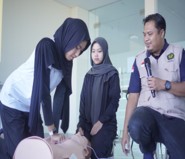
Kegiatan pengabdian ini bertujuan mengembangkan dan mengimplementasikan sistem Code Blue untuk memperkuat kesiapsiagaan menghadapi dugaan henti jantung di Fakultas Ilmu Keolahragaan Universitas Negeri Malang (FIK UM). Pelaksanaan mencakup identifikasi kebutuhan, pembentukan tim, penyusunan prosedur operasional standar (SOP), penempatan automated external defibrillator (AED), pelatihan Basic Life Support (BLS), dan simulasi skala penuh. Pengetahuan peserta dievaluasi secara deskriptif melalui pre-test dan post-test, sedangkan keterlaksanaan respons diamati dalam satu skenario simulasi di lintasan lari. Program menghasilkan tim inti beranggotakan 25 personel, SOP yang disesuaikan dengan tata ruang fakultas, dan tiga unit AED yang ditempatkan di area administrasi, olahraga, dan laboratorium. Pelatihan BLS diikuti oleh 50 peserta. Rata-rata skor pengetahuan meningkat dari 42,5 menjadi 89,4 pada skala 0–100, dengan selisih 46,9 poin. Dalam simulasi, sistem diaktifkan 45 detik setelah kejadian dikenali, dan tim melaksanakan alur respons hingga tahap analisis AED secara simulatif. Hasil kegiatan menunjukkan keterlaksanaan awal sistem Code Blue di FIK UM dalam kondisi simulasi. Retensi pengetahuan, keterampilan praktik yang dinilai secara terstandar, dan efektivitas respons pada kejadian nyata masih memerlukan evaluasi lanjutan.
The Code Blue Initiative at the Faculty of Sports Sciences, Universitas Negeri Malang, as a Model for Medical Emergency Response in Higher Education
This community engagement program aimed to develop and implement a Code Blue system to strengthen preparedness for suspected cardiac arrest at the Faculty of Sports Sciences, Universitas Negeri Malang (FIK UM). The program included a needs assessment, team formation, development of a standard operating procedure (SOP), placement of automated external defibrillators (AEDs), Basic Life Support (BLS) training, and a full-scale drill. Changes in knowledge were assessed descriptively using pre- and post-training tests, while the response procedure was observed in a single simulated scenario on a running track. The program established a 25-member core team, developed an SOP adapted to the faculty’s layout, and placed three AEDs in administrative, sports, and laboratory areas. Fifty participants attended the BLS training. The mean knowledge score rose from 42.5 to 89.4 on a 0–100 scale, a difference of 46.9 points. During the drill, the system was activated 45 seconds after the incident was recognized, and the team carried out the response procedure through simulated AED rhythm analysis. These findings document the initial implementation of the Code Blue system under simulated conditions. Knowledge retention, performance measured using standardized practical assessments, and response effectiveness in actual emergencies require further evaluation.
Downloads
References
Apiratwarakul, K., Cheung, L. W., Pearkao, C., Gaysonsiri, D., & Ienghong, K. (2024). “Smart Emergency Call Point” enhancing emergency medical services on university campuses. Prehospital and Disaster Medicine, 39(1), 32–36. https://doi.org/10.1017/S1049023X23006647
Bender, J. A., Mills, P. D., Kulju, S. F., & Turner, J. R. (2026). Enhancing Code Blue, rapid response, and emergency response safety in the Veterans Health Administration: Using a combined proactive risk assessment (CPRA) approach to detect failure modes and identify improvement actions. The Joint Commission Journal on Quality and Patient Safety, 52(1), 9–25. https://doi.org/10.1016/j.jcjq.2025.10.005
Bovbjerg, V. E. (2020). Emergency medical response to US sports injuries. Injury Prevention, 26.
Chang, Y.-T., Wu, K.-C., Yang, H.-W., Lin, C.-Y., Huang, T.-F., Yu, Y.-C., & Hu, Y.-J. (2023). Effects of different cardiopulmonary resuscitation education interventions among university students: A randomized controlled trial. PLOS ONE, 18(3), e0283099. https://doi.org/10.1371/journal.pone.0283099
Coris, E. E., Miller, E., & Sahebzamani, F. (2005). Sudden cardiac death in Division I collegiate athletics: Analysis of automated external defibrillator utilization in National Collegiate Athletic Association Division I athletic programs. Clinical Journal of Sport Medicine, 15(2), 87–91. https://doi.org/10.1097/01.jsm.0000152715.12721.fa
D’Cunha, R. J., Fernandes, S. F., & Sherif, L. (2021). Utility of simulation as a teaching tool for nursing staff involved in Code Blue management. Indian Journal of Critical Care Medicine, 25(8), 878–880. https://doi.org/10.5005/jp-journals-10071-23912
Drezner, J. A., Rao, A. L., Heistand, J., Bloomingdale, M. K., Harmon, K. G., Berger, S., & Campbell, R. M. (2009). Effectiveness of emergency response planning for sudden cardiac arrest in United States high schools with automated external defibrillators. Circulation,120(6),518–525.https://doi.org/10.1161/CIRCULATIONAHA.109.855890
Drezner, J. A., Rogers, K. J. (2006). Sudden cardiac arrest in intercollegiate athletes: Detailed analysis and outcomes of resuscitation in nine cases. Heart Rhythm, 3(7), 755–759. https://doi.org/10.1016/j.hrthm.2006.03.023
Gu, Q. (2025). Research on safety hazards and emergency management system of campus sports facilities. Journal of Modern Educational Theory and Practice, 1(4). https://doi.org/10.70767/jmetp.v1i4.513
Karam, N., Marijon, E., & Jouven, X. (2023). Association between basic life support and survival in sports-related sudden cardiac arrest: A meta-analysis. European Heart Journal, 44(3), 180–192. https://doi.org/10.1093/eurheartj/ehac586
Khatib, A., Dababneh, S., Ng, T., Chu, W., McKinney, J., Chakrabarti, S., Allan, K., & Laksman, Z. (2024). Short survey on cardiopulmonary resuscitation and automated external defibrillator training in rural British Columbia schools: Preliminary findings and hypothesis-generating insights. CJC Open, 6(10), 1240–1247. https://doi.org/10.1016/j.cjco.2024.07.006
Khrabra, S., Kovalenchenko, V., Barladin, O., Vakulenko, L., et al. (2025). Pre-medical care in case of emergency in physical culture and sports. Scientific Journal of National Pedagogical Dragomanov University Series 15: Scientific and Pedagogical Problems of Physical Culture (Physical Culture and Sports). https://doi.org/10.31392/UDU-nc.series15.2025.06(193).36
Liaw, S. Y., Chew, K. S., Zulkarnain, A., Wong, S. S. L., Singmamae, N., Kaushal, D. N., & Chan, H. C. (2020). Improving perception and confidence towards bystander cardiopulmonary resuscitation and public access automated external defibrillator program: How does training program help? International Journal of Emergency Medicine, 13, 13. https://doi.org/10.1186/s12245-020-00271-3
Michelland, L., Murad, M. H., Bougouin, W., Van Der Broek, M., Prokop, L. J., Anys, S., Perier, M.-C., Cariou, A., Empana, J.-P., Marijon, E., Jouven, X., & Jabre, P. (2023). Association between basic life support and survival in sports-related sudden cardiac arrest: A meta-analysis. European Heart Journal, 44(3), 180–192. https://doi.org/10.1093/eurheartj/ehac586
Nishiyama, C., Sato, R., Baba, M., Kuroki, H., Kawamura, T., Kiguchi, T., Kobayashi, D., Shimamoto, T., Koike, K., Tanaka, S., Naito, C., & Iwami, T. (2019). Actual resuscitation actions after the training of chest compression-only CPR and AED use among new university students. Resuscitation, 141, 63–68. https://doi.org/10.1016/j.resuscitation.2019.05.040
Risaliti, C., Evans, K., Buehler, J., Besecker, B., & Ali, N. (2018). Decoding Code Blue: A process to assess and improve code team function. Resuscitation, 122, e15–e16. https://doi.org/10.1016/j.resuscitation.2017.11.039
Toft, L. E. B., Bottinor, W., Cobourn, A., Blount, C., Tripathi, A., Mehta, I., & Koch, J. (2023). A simulation-enhanced, spaced learning, interprofessional “code blue” curriculum improves ACLS algorithm adherence and trainee resuscitation skill confidence. Journal of Interprofessional Care, 37(4), 623–628. https://doi.org/10.1080/13561820.2022.2140130
Ungaro, S., Truglio, T. S., Zorzi, A., Solberg, E. E., Caniglia, A., Panhuyzen-Goedkoop, N. M., Chukumerije, M., Marijon, E., & Drezner, J. A. (2026). Sports-related sudden cardiac arrest: A video analysis of presenting features, management and outcomes. British Journal of Sports Medicine, 60(1), 20–27. https://doi.org/10.1136/bjsports-2025-110275
Ward, C. A., Berry, M., & Bou-Habib, M. (2025). Roles of anesthesia assistants within the code blue team at in-hospital cardiopulmonary arrests: A retrospective analysis. Canadian Journal of Respiratory Therapy, 61, 78–86. https://doi.org/10.29390/001c.136463
Downloads
Published
Issue
Section
License
Copyright (c) 2026 Kumoro Asto Lenggono, Moh Yudha Isnaini, Fajar Raya Ferdinal Kusuma Bakti, Kurniati Rahayuni, 5Raden Muhammad Nuvail Rasyid, Puput Saputri

This work is licensed under a Creative Commons Attribution-ShareAlike 4.0 International License.
Authors who publish with Sasambo: Jurnal Abdimas (Journal of Community Service) agree to the following terms:
- Authors retain copyright and grant the journal right of first publication with the work simultaneously licensed under a Creative Commons Attribution-ShareAlike 4.0 International License that allows others to share the work with an acknowledgment of the work's authorship and initial publication in this journal.
- Authors are able to enter into separate, additional contractual arrangements for the non-exclusive distribution of the journal's published version of the work (e.g., post it to an institutional repository or publish it in a book), with an acknowledgment of its initial publication in this journal.
- Authors are permitted and encouraged to post their work online (e.g., in institutional repositories or on their website) prior to and during the submission process, as it can lead to productive exchanges, as well as earlier and greater citation of published work (See The Effect of Open Access).

This work is licensed under a Creative Commons Attribution-ShareAlike 4.0 International License.


