
Edukasi dan Demonstrasi Penyiapan Campuran Eco-Enzim dari Kulit Buah dan Sayuran di SMKN 1 Pringgarata
Authors
-
Baiq Dina Hardianti
 Universitas Qamarul Huda Badaruddin
-
Faizul Bayani
Universitas Qamarul Huda Badaruddin
-
Meilynda Pomeistia
Universitas Qamarul Huda Badaruddin
-
Rahman Rahman
Universitas Qamarul Huda Badaruddin
-
Temi Ainul Syafitri
Universitas Qamarul Huda Badaruddin
-
Thauhidayatul Hidayah
Universitas Qamarul Huda Badaruddin
-
Sudirman Sudirman
Universitas Qamarul Huda Badaruddin
DOI:
https://doi.org/10.36312/sasambo.v8i4.7147Keywords:
eco-enzim, Limbah Organik, demonstrasi, sekolah kejuruan, evaluasi berpasanganAbstract
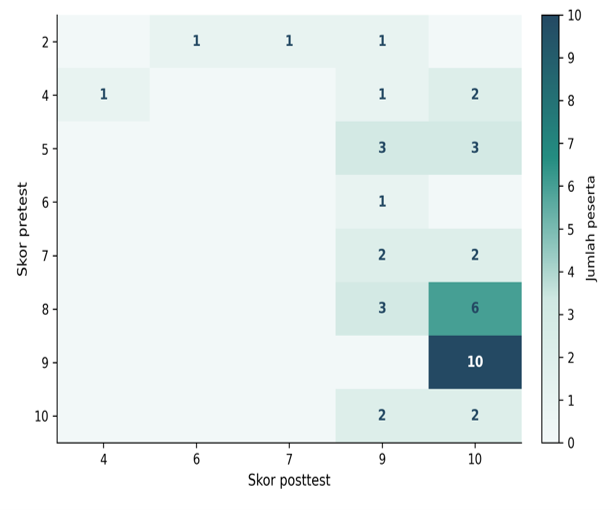
Pengolahan kulit buah dan sayuran dapat dijadikan konteks edukasi pengelolaan sampah organik di sekolah kejuruan. Kegiatan pengabdian ini bertujuan mengenalkan langkah awal penyiapan campuran fermentasi eco-enzim dan menggambarkan perubahan skor evaluasi peserta di SMKN 1 Pringgarata, Lombok Tengah, pada 17 September 2026. Program mencakup penyampaian materi, demonstrasi bahan dan wadah, peragaan pencampuran, serta pretest dan posttest. Dokumentasi menunjukkan wadah dan bahan organik yang digunakan dalam peragaan; keterampilan setiap peserta dan mutu produk matang tidak diukur. Dari 42 catatan peserta, 41 memuat pasangan nilai lengkap. Rerata skor meningkat dari 7,02 ± 2,35 menjadi 9,37 ± 1,20 (kenaikan 2,34 poin); 36 peserta (87,80%) meningkat, tiga (7,32%) tetap, dan dua (4,88%) menurun. Uji Wilcoxon signed-rank menunjukkan perbedaan bermakna (p < 0,001). Kegiatan menghasilkan demonstrasi penyiapan campuran dan peningkatan skor tes setelah pelatihan, tetapi belum membuktikan efektivitas kausal, penguasaan keterampilan praktik, ataupun kualitas eco-enzim setelah fermentasi. Pendampingan bersama sekolah hingga tahap panen dan evaluasi keterampilan diperlukan.
Education and Demonstration of Eco-Enzyme Mixture Preparation from Fruit and Vegetable Peels at SMKN 1 Pringgarata
Fruit and vegetable peels offer a practical context for organic-waste education in vocational schools. This community service activity introduced the initial preparation of an eco-enzyme fermentation mixture and described changes in assessment scores at SMKN 1 Pringgarata, Central Lombok, Indonesia, on 17 September 2026. Activities included educational instruction, demonstration of materials and containers, mixture preparation, and pretest–posttest assessments. Photographs documented the preparation process, but individual practical competence and the quality of matured products were not measured. Of 42 participant records, 41 contained complete paired scores. The mean score increased from 7.02 ± 2.35 to 9.37 ± 1.20 (mean difference: 2.34 points); 36 participants (87.80%) improved, three (7.32%) remained unchanged, and two (4.88%) declined. The Wilcoxon signed-rank test showed a significant paired difference (p < 0.001). The activity demonstrated initial eco-enzyme mixture preparation and was followed by improved test scores. Without a control group, a validated skills assessment, or fermented-product testing, neither causality nor practical competence or final product quality can be established. Follow-up mentoring with the school is recommended.
Downloads
References
Amananti, W., Riyanta, A. B., Tivani, I., & Susiyarti, S. (2024). Increasing knowledge and skills in processing orange peel waste into eco enzymes for senior high school students. Journal of Community Service and Empowerment, 5(2), 415–421. https://doi.org/10.22219/jcse.v5i2.32633
Amananti, W., Tivani, I., & Riyanta, A. B. (2025). Guidance on making eco-enzymes from banana peel waste for Bulakamba vocational school students to improve skills in waste processing. International Journal of Community Service Learning, 9(4), 751–758. https://doi.org/10.23887/ijcsl.v9i4.91402
Ardiani, F., Noviana, G., Astuti, Y. T. M., & Rochmiyati, S. M. (2023). Sosialisasi pemanfaatan limbah kulit buah kakao melalui pelatihan pembuatan eco-enzyme. Sasambo: Jurnal Abdimas (Journal of Community Service), 5(3), 523–530. https://doi.org/10.36312/sasambo.v5i3.1318
Benny, N., Shams, R., Dash, K. K., Pandey, V. K., & Bashir, O. (2023). Recent trends in utilization of citrus fruits in production of eco-enzyme. Journal of Agriculture and Food Research, 13, 100657. https://doi.org/10.1016/j.jafr.2023.100657
Eco Enzyme Nusantara. (2023). Modul dasar pembuatan eco enzyme bagi pemula (Revisi Juni 2023).
Gumilar, G. G., Kadarohman, A., Fakhrurozi, M. F., Nahadi, Supriyanti, F. M. T., & Munawaroh, H. S. H. (2025). Characterization and enzymatic evaluation of ecoenzyme derived from fruit and vegetable waste: An effort to achieve zero waste concept. Baghdad Science Journal, 22(4), 1175–1184. https://doi.org/10.21123/bsj.2024.10707
Kahar, K., Iqbal, M., & Kamaludin, A. (2023). Pelatihan pembuatan kompos eco enzyme di Kelurahan Sukasari Kota Bandung. Jurnal Pengabdian Masyarakat Kesehatan Indonesia, 2(2), 269–277. https://doi.org/10.34011/jpmki.v2i2.1737
Selviana, S., & Ramaja, S. P. (2025). Promosi PHBS dan pemanfaatan limbah dapur sebagai eco enzyme di Pondok Pesantren Raudhatul Firdaus. Sasambo: Jurnal Abdimas (Journal of Community Service), 7(4), 774–783. https://doi.org/10.36312/sasambo.v7i4.3661
Supriana, T., Emalisa, Indriani, V., & Salsabillah. (2026). Community empowerment through eco-enzyme production training for organic waste management in Pematang Johar Village. Journal of Saintech Transfer, 9(1), 66–72. https://doi.org/10.32734/jst.v9i1.24400
Surtikanti, H. K., Kusumawaty, D., Sanjaya, Y., Kusdianti, Priyandoko, D., Kurniawan, T., Kartika, & Sisri, E. M. (2021). Memasyarakatkan ekoenzim berbahan dasar limbah organik untuk peningkatan kesadaran dalam menjaga lingkungan. Sasambo: Jurnal Abdimas (Journal of Community Service), 3(3), 110–118. https://doi.org/10.36312/sasambo.v3i3.532
Downloads
Published
Issue
Section
License
Copyright (c) 2026 Baiq Dina Hardianti, Faizul Bayani, Meilynda Pomeistia, Rahman Rahman, Temi Ainul Syafitri, Thauhidayatul Hidayah, Sudirman Sudirman

This work is licensed under a Creative Commons Attribution-ShareAlike 4.0 International License.
Authors who publish with Sasambo: Jurnal Abdimas (Journal of Community Service) agree to the following terms:
- Authors retain copyright and grant the journal right of first publication with the work simultaneously licensed under a Creative Commons Attribution-ShareAlike 4.0 International License that allows others to share the work with an acknowledgment of the work's authorship and initial publication in this journal.
- Authors are able to enter into separate, additional contractual arrangements for the non-exclusive distribution of the journal's published version of the work (e.g., post it to an institutional repository or publish it in a book), with an acknowledgment of its initial publication in this journal.
- Authors are permitted and encouraged to post their work online (e.g., in institutional repositories or on their website) prior to and during the submission process, as it can lead to productive exchanges, as well as earlier and greater citation of published work (See The Effect of Open Access).

This work is licensed under a Creative Commons Attribution-ShareAlike 4.0 International License.


